Lockbox Appliance
Mainstay is the application. Lockbox is the appliance.
Lockbox is the hardware platform for supporting a locally running Mainstay instance and its services. It gives that deployment a dedicated local home and serves people and communities that need durable storage, predictable service operation, local networking, and hardware-backed controls.
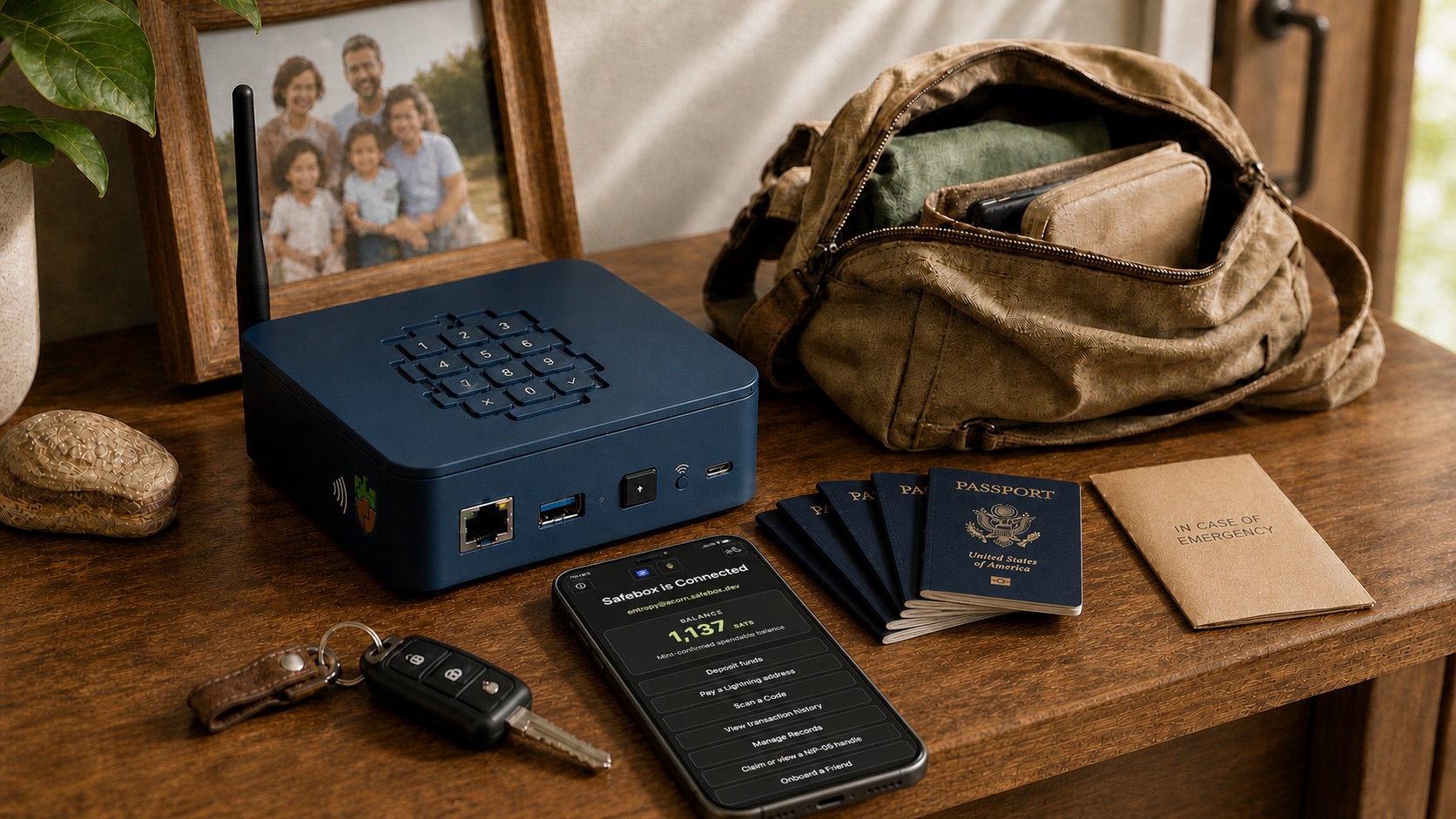
Initial platform direction
FreeBSD on Raspberry Pi 4
with a physical keypad and TROPIC01 HSM
- FreeBSD provides a small, inspectable, service-oriented base.
- Raspberry Pi 4 supplies a low-power initial hardware target.
- TROPIC01 is the planned hardware-backed key and signing boundary.
- The keypad supplies local presence for unlock, approval, and recovery.
Appliance profile
A Lockbox deployment can run:
- Mainstay as the unified user application;
- Safebox Web as the current application foundation;
- Acorn for keys, records, proofs, signing, and recovery;
- Stroma as Acorn's narrow Nostr wire-format library;
- Spurline for local Nostr event continuity;
- Grove for encrypted blob storage; and
- optionally, Clear for a locally governed currency or voucher system.
Not every Lockbox needs every component. Clear in particular must be an explicit organizational choice: operating an appliance must never silently make someone a currency issuer.
Stroma is packaged with the software that uses it rather than operated as a separate appliance service. It keeps Acorn's Nostr protocol dependency small and inspectable while Spurline remains an independently replaceable relay.
Local Approval
Network services can assist. Sensitive actions stay locally approved.
Remote services may improve availability. The planned hardware-backed policy and physical-approval boundary constrains high-risk local actions: the web app can request an operation, while the local boundary decides whether it may proceed.
Appliance, not general-purpose server
The Lockbox appliance profile specifies predictable boot, clear health information, stable local service addresses, documented data locations, and safe backup, migration, restart, and shutdown behavior.
The first goal is a coherent local profile for the existing sibling products, not a generic home-server platform or a monolithic rewrite.